Tuesday, May 4, 2010

Kashia Pomo lose fishing grounds

On an ocean bluff above a resting seal and relentless waves, Kashia Pomo leaders Friday voiced opposition to new state rules that prohibit harvesting fish and other sea life at Stewarts Point.


The rules, which take effect today, establish a series of state preserves intended to help restore California's marine ecosystems.

But to the Indians with ties to Stewarts Point, the fishing ban there harms their culture, their ceremonies and the transmission of traditions to future generations.

“Today I'm going to tell you they are interfering with our religion,” Violet Parrish Chappell, a Kashia Pomo elder, told Indians and supporters who came together just up the road from the Stewarts Point Store. “And I don't think they would do that to the Catholic Church.”

About 130 people stood Friday in bright sun and constant wind on a ranch owned by the Richardson family, which settled the area 130 years ago and controls about 15,000 acres.

Arch Richardson, an elder among the family's 85 descendants, invited leaders from the Stewarts Point Rancheria to bless the bluff and to mark the last day when fishing was permitted there. About a half-dozen tribal members harvested abalone in the nearby surf earlier in the day.

rest at

http://www.pressdemocrat.com/article/20100430/ARTICLES/100439928&tc=email_newsletter?p=all&tc=pgall&tc=ar

Wednesday, April 28, 2010

Ruby pipeline threatens Fort Bidwell sacred sites

Despite pleas to avoid ancient Indian gathering areas and pristine wildlife areas, Washoe County commissioners tonight approved a permit for a pipeline to carry natural gas from Wyoming to Oregon across the northern part of the county.

Aaron Townsend, of the Fort Bidwell Indian Community Council in California, said the lands in northern Washoe between Vya and the Sheldon National Wildlife Refuge are aboriginal territory.

“This where our people have come since the beginning of time,” he said, adding hundreds of art rock features, tribal sites and plants used in rituals would be ruined.
“This will destroy this pristine area,” said Charles Reed, also of Fort Bidwell.

He said the land supports mule deer, bobcats, golden eagles and three subspecies of pygmy rabbits.

Reed proposed the pipeline be re-routed to Highway 140 from Denio to Lakeview or along a railroad line north of Gerlach where there is sparse vegetation.

rest at

http://www.rgj.com/article/20100427/NEWS/100427075/-1/CARSON/Commission-OKs-permit-for-pipeline-across-northern-part-of-Washoe-County


Wednesday, April 14, 2010

WASHINGTON – Scientists are considering a lawsuit against a new rule that would help repatriate thousands of Native American remains to tribes across the nation.

The rule, published March 15 and open for comment for 60 days, is a clarification from the Interior Department to the 1990 Native American Graves Protection and Repatriation Act. It states that after appropriate tribal consultation, transfer of culturally unidentifiable remains is to be made to a tribe from whose tribal or aboriginal lands the remains were excavated or removed. Civil penalties are proposed for museums and learning institutions that do not follow the law.

The development has been largely celebrated by Native American communities, although tribal advocates say it has shortcomings, like not including sacred culturally unidentifiable funerary objects in its scope. Some tribes are using the open comment period to make that concern known, noting that common law and some state laws require repatriation of such objects.

Some scientists, however, are outraged by the new rule, believing that important human knowledge could be lost if the remains go back to tribes.

rest at

http://www.indiancountrytoday.com/national/90350684.html


Once again, we urge tribal members to let the Federal government know how they feel about the law!

Wednesday, April 7, 2010

Challenges to 43 CFR 10.11?

Some museums — including the American Museum of Natural History in New York, the Field Museum in Chicago, Illinois, and the Peabody Museum of Archaeology and Ethnology at Harvard University in Cambridge, Massachusetts — are discussing whether they will challenge the rule. The issue could have the same import as the long legal fight to study the 9,000-year-old Kennewick man skeleton against Native American wishes (see Nature 436, 10; 2005). In 2004, scientists won that court battle, affirming the principle that bones would be returned only to culturally related tribes.

Anthropologists and archaeologists are also gearing up to debate the rule. Discussions have already been scheduled for the annual meeting of the American Association of Physical Anthropology, which starts on 14 April in Albuquerque, New Mexico, and the Society for American Archaeology meeting, which begins on the same day in St Louis, Missouri.

read it all at http://www.nature.com/news/2010/100331/full/464662a.html

Tuesday, April 6, 2010

UM news

WASHINGTON – A new rule involving the Native American Graves Protection and Repatriation Act has one of the nation’s largest research institutions preparing to return a collection of more than 1,300 Native American human remains.

The University of Michigan in Ann Arbor announced March 26 that officials there have begun outlining a process for the transfer of Native American human remains to tribes.

The activity comes as a result of the U.S. Department of the Interior’s March 15 publication of a final rule clarifying how museums and institutions should handle Native American human remains that are under their control, but for which no culturally affiliated Indian tribe has been identified.

rest at http://www.indiancountrytoday.com/archive/89775852.html

Saturday, March 20, 2010

More news on Univ. of Michigan

New rule to prompt University of Michigan to re-examine holdings of Native American human remains

The University of Michigan will have to re-examine its holdings of Native American human remains under a change to federal guidelines announced today.

The U-M Museum of Anthropology has about 1,400 human remains in a storage facility that are 800 to 3,000 years old.

The 1990 Native American Graves Protection and Repatriation Act, known as NAGPRA, requires museums, federal agencies and institutions to inventory holdings of human remains and identify their cultural affiliations with tribes. Native groups can then claim the return of remains deemed to be culturally affiliated with them.

031510_native_american_remains.jpg

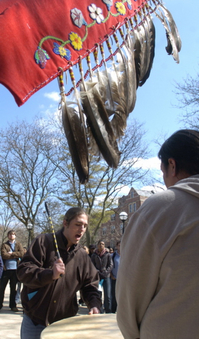
Frank Bartley III, an Odawa Indian and a U-M student, beats the drum and sings with other Native Americans in front of Fleming Hall in Ann Arbor before a U-M regents meeting in this 2008 file photo. The gathering was part of a request to the regents to return Native-American remains.

Ann Arbor News file photo

What to do with the vast number of human remains where cultural identity hasn't been determined hadn't been fully addressed in the law and has been a sticking point between the University of Michigan and some Native American groups. U-M has designated the 1,380 human remains it stores "culturally unidentifiable."

Under the rule change, U-M museum officials would need to alert modern-day federal tribes of any "culturally unidentifiable" human remains it has that were discovered near areas the tribes historically occupied. Those tribes could ask for the remains to be returned based on the geographic link. A national review committee would settle disputes between tribes. The change will take effect in May.

rest at

http://www.annarbor.com/news/new-rule-prompts-university-of-michigan-to-re-examine-holdings-of-native-american-human-remains/


Tuesday, March 16, 2010

You can download/read 43 CFR Part 10 at

http://frwebgate3.access.gpo.gov/cgi-bin/TEXTgate.cgi?WAISdocID=74193128557+0+1+0&WAISaction=retrieve

Like we said yesterday, by all means send your comments in!

Sunday, March 14, 2010

CUI RULE TO PUBLISH MARCH 15

The reserved section of the NAGPRA regulations, 10.11, the disposition of culturally unidentifiable Native American human remains, is set to publish on Monday, March 15, as a final rule. The rule will be effective on May 14, 2010. During the 60 days, the public may submit additional comments on the rule to Regulations.gov. The comments will thereafter be considered as to whether amendment to the rule is appropriate.

The National NAGPRA Program will offer a webinar prior to the comment deadline, which will include a training on the rule. The webinar date will be announced shortly anticipating a 200 capacity access line.

from http://www.nps.gov/nagpra/

NO MATTER WHAT THESE RULES SAY, TRIBAL CHAIRS, THPOs, and CULTURAL HERITAGE OFFICERS SHOULD SEND A LETTER TO THE GOVERNMENT AND COMMENT ON THE NEW RULES!!! The archaeologists sure will!

Saturday, March 13, 2010

Glen Cove debate

Plans by Vallejo to turn a scraggly stretch of waterfront on the Carquinez Strait into a park with paved parking, trails and restrooms are infuriating local Ohlone Indians who say the 15-acre site is sacred and should be left alone.

The property is Glen Cove Park, a spot that was the site of a 3,500-year-old Ohlone village and shell mound where thousands of people were buried.

The settlement is one of the oldest Ohlone sites in the Bay Area and among the few that has eluded development. But for decades, Vallejo has wanted to convert the wildland to a park with a portion of the Bay Trail, picnic tables and a pastoral array of native plants.

"What we want to do is return it to what it was 100 years ago," said Steve Pressley, maintenance and development manager for the Greater Vallejo Recreation District. "As an agency, we have a responsibility to the public as a whole, and we need to consider all the components, not just the needs of Native Americans."

Saturday, March 6, 2010

OMB meeting on new NAGPRA regulations

For objections to the new rules on the culturally unidentifiable human remains,
check out:

http://www.whitehouse.gov/omb/1024_meeting_110409/

(Go to the bottom of the page for the objections)

Any surprise on who is objecting?